

Human connections are vital to successful workplaces. For one, they boost employee well-being. According to a recent study, 69.5% of employees say they would be happier if they had deeper connections with colleagues. They also boost business outcomes, with 94% of workers agreeing they’re more productive when they feel connected to colleagues.
According to Xavier Keeley, Strategist, Managed Collaboration Service at HP, this is because we are social beings: “Individuals need shared purpose and a sense of belonging to do their best work. That’s what drives engagement, collaboration and innovation.”
Building connections in a changing environment
When everyone works from the office, human connections occur naturally, and it is easy to reinforce culture and build relationships. Hybrid working changes that.
“The water-cooler chats, quick sense checks and creative sparks that come from people spending time together have become rarer,” says Keeley. “Few organisations have even set out a plan for how to recreate that sense of connection in the hybrid office.”
Left unaddressed, the world of work risks becoming disconnected and transactional, and organisations lose the serendipity that fuels innovation.
However, rigid back-to-the-office mandates do not work. Blanket policies ignore the realities of how different roles and teams work. “People in different roles and life stages need different balances,” says Keeley. “Successful organisations will design thoughtful, role-based strategies that build connection, belonging and performance.”
Creating meeting equity
The rise of ever more powerful communications technology means that, on paper, hybrid collaboration has never been easier. But as Keeley explains, while technology is an important enabler for connection, it’s not sufficient. “Technology is only as good as the strategy it serves,” he says.
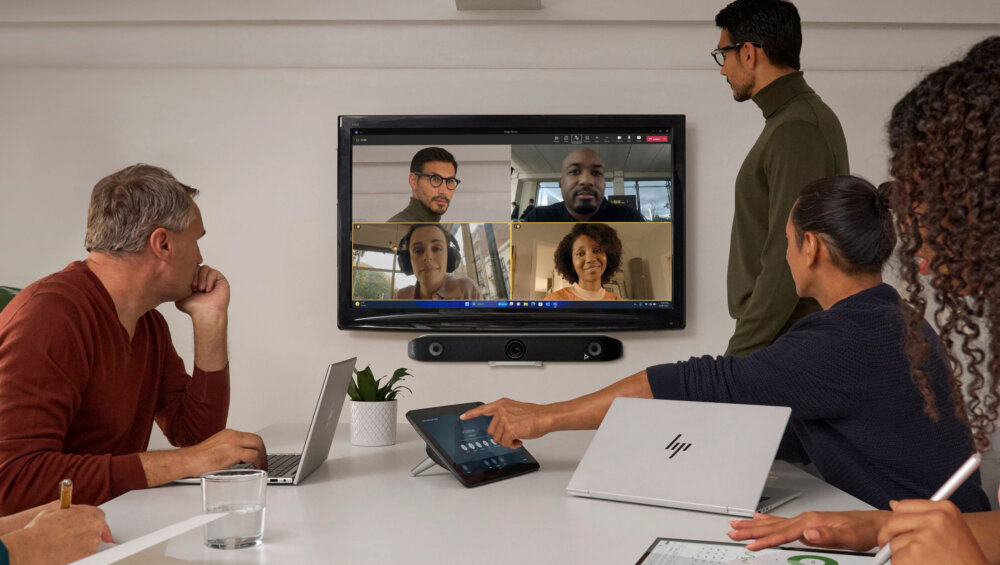
Take meeting equity as an example: the principle that every worker should have an equal ability to see, hear, be heard and contribute to meetings, regardless of whether they’re connecting remotely or are working from a collaboration space.
Kitting out collaboration rooms with high-quality audio-visual equipment and giving home/remote workers the necessary equipment to participate is only part of the solution. “Meeting equity starts with good room design,” says Keeley. “When spaces are planned so that everyone joins the conversation, participation flows naturally. When they’re not, valuable voices are often lost simply because people can’t easily contribute.”
When it comes to technology, reliability and simplicity are key. People should be able to walk into a room, press a button and start the meeting immediately. If the technology is complicated or unreliable then people will vote with their feet, avoiding the tools altogether or simply going ahead with whoever happens to be in the room.
Founding collaboration strategies on data insights
Once the right rooms, technology and behaviours are in place, the next challenge is visibility. How does IT know that it’s all working as intended and that users are having a good experience?
This is where data insights come into play. Keeley explains: “Organisations need insight into how collaboration spaces are being used. This needs to a include a real-time view of the user experience so that issues can be addressed the moment they arise and – ideally before the next meeting starts and more users are impacted.” Keely adds: “There also needs to be a macro view to enable appropriate estate evolution and updates: Are rooms occupied as often as expected? Are they being used for hybrid collaboration or mostly for in-person meetings? How many people are really in the room? If a 10-person space is consistently being used by just two people, that’s a major inefficiency.”
Data surfaced by digital experience platforms like HP Workforce Experience delivers crucial usage insights. Armed with usage data, organisations can move to a structured approach for connecting workers. Keeley outlines three key steps for IT teams to consider:
- Start with real use cases. Every organisation collaborates differently. A manufacturer may need high-resolution cameras to zoom in on circuit boards, for example, while a project team may prioritise whiteboarding. Mapping these use cases provides the foundation for effective room design.
- Design for the 80/20 rule. Most collaboration requirements are predictable. Create reusable design templates that cover around 80% of cases where standard meeting rooms are suitable. The remaining 20% are more complex environments, such as boardrooms, town halls and divisible spaces, which should be treated as specialist environments needing more bespoke design.
- Build a governance and data foundation. Finally, manage collaboration spaces like strategic assets. Strong governance, backed by usage and performance data (both real-time alerting and analytic), ensures rooms are used effectively, issues are identified early and designs evolve as needs change.
While some organisations might choose to go it alone, others will benefit from the end-to-end hardware and wrap-around care that comes from working with partners like HP. “HP provides end-to-end services that support the entire collaboration experience,” concludes Keeley. “This includes designing meeting rooms through standardised templates, building the management processes behind them and ensuring ongoing reliability through services that make rooms easy to use and consistently operational — which underpins delivery of a consistently excellent user experience which can be measured.”
The nature of work has changed forever, but that doesn’t mean that great human connections cannot be built and maintained. The key to success is putting structured data at the heart of collaboration strategies so that technology investments deliver ever-improving user experiences.
Click here to find out how HP can help your business collaborate for success.